
What to Do If the Airline Ignores Your Flight Delay Claim?
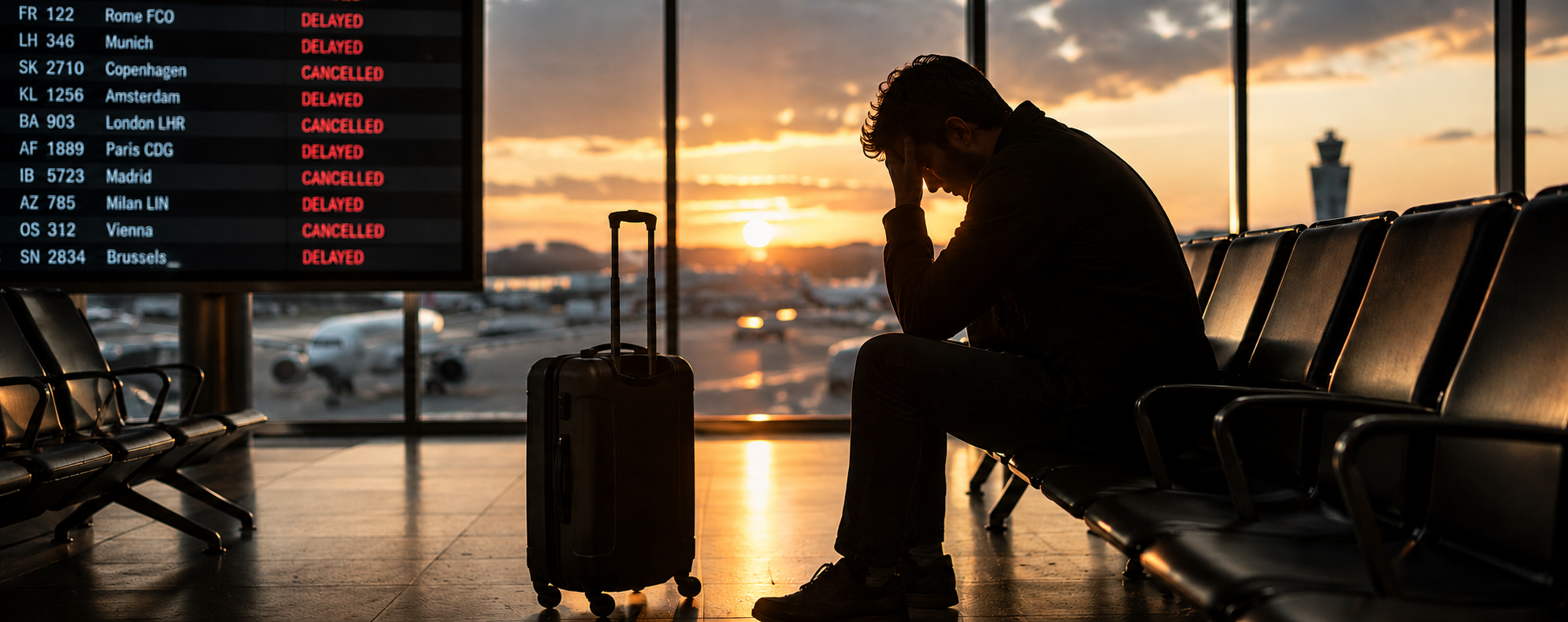
It happens to the best of us: you've spent hours stuck in a crowded terminal, your travel plans are ruined, and the only thing keeping you going is the thought that, legally, the airline owes you for the trouble. But then the email arrives. Your flight compensation claim has been denied.
Rejections are incredibly frustrating, but you aren't alone. In fact, over half of eligible claims are wrongfully rejected at the first attempt. Airlines often use a calculated refusal strategy, banking on passengers giving up after the first denial. Understanding the legal reality behind these responses is the first step toward getting what you are rightfully owed.
- Airlines use a calculated refusal strategy to reject valid compensation claims, banking on passengers giving up after the first denial.
- Over half of eligible claims are initially met with a wrongful rejection.
- Common excuses, such as "technical faults" or "knock-on delays," are often legally invalid because they are considered part of normal operational risk.
- ClaimFlights acts as your Passenger Advocate, offering complete claim handling and a competitive success fee with no financial risk.
Why Many Valid Claims Are Initially Turned Down (Rejection Reality)
There is a massive gap between what the law promises and what travelers actually receive. Airlines often reject more valid claims than they accept; industry data shows that many eligible claims are wrongfully rejected right out of the gate.
This is often a calculated refusal strategy. Airlines may bank on the fact that most passengers don't have the legal resources or the technical flight data to challenge a rejection. By saying "no" initially, they successfully discourage a large percentage of people from ever following up.
9 Common Excuses Airlines Use to Avoid Paying You
When an airline denies a claim, they usually rely on standard justifications. Here are the most common reasons cited—and why they often don't hold up:
1. Extraordinary Circumstances
Extraordinary Circumstances is one of the ultimate "catch-all" excuses. While valid for things like political instability or security risks, airlines often apply it to almost any disruption. However, many situations they label "extraordinary" are actually part of their normal operational risk and are legally compensable.
2. Extreme Weather
Airlines frequently blame weather conditions, even if the sun is shining at your departure and arrival airports. They might cite weather issues from a previous flight "rotation" or distant air traffic, but if other flights were taking off normally, this excuse often doesn't hold up in court.
3. Technical Problems
Airlines often claim a technical fault was unexpected, but European courts have ruled that most technical issues are inherent in the normal operation of an aircraft. Unless caused by sabotage or a manufacturer's defect, the airline is usually still liable.
4. Air Traffic Control (ATC) Restrictions
Airlines love to shift the blame to third parties like Air Traffic Control. While genuine ATC strikes or capacity issues can be valid defenses, airlines sometimes use this as a blanket excuse for their own scheduling failures or staffing shortages.
5. Strikes
Airlines often point to strikes as a reason to deny compensation. However, under EU 261 Regulation, strikes involving the airline's own staff, such as pilots or cabin crew, are generally considered foreseeable events. In such cases, passengers may still be eligible for compensation.
6. Total "Radio Silence" (Ignored Claims)
Ignoring a claim completely is an extremely common airline tactic. According to industry data, over a quarter of claims are simply met with radio silence. Airlines treat this like a waiting game, hoping the passenger will forget or give up before the legal time limit to file expires.
7. The "Voucher" or Goodwill Gesture Trap
Airlines frequently try to avoid paying cash by offering a travel voucher as a "goodwill gesture". Under EU Regulation 261/2004, compensation must be paid in cash or bank transfer unless the passenger gives signed, written permission to accept a voucher.
8. "Insufficient Documents" and Bureaucracy
Airlines sometimes reject valid claims by demanding unreasonable extra paperwork or claiming the provided documents are insufficient. This is a tactic explicitly meant to bury the passenger in bureaucracy and discourage them from continuing the process.
9. "Knock-On" or Rotational Delays
Airlines often blame a delay on a previous flight arriving late (a knock-on effect). Operational planning and aircraft rotation are the airline's responsibility, and a delay on a previous flight is generally not a valid "extraordinary circumstance" for your flight.
Beyond the Excuse: Turning a "No" Into Your Payout
A rejection isn't the end of the road; it's often just a tactic to see if you will give up. This is where a legal plausibility check becomes essential. By using independent flight, weather, and operational data, you can uncover whether the airline's excuse is factually true or just a legal shield to avoid payment.
Your Options After a Rejection
If your claim has been denied, it means your initial request was unsuccessful. You can still escalate your case through one of these three paths:
- Flight Claim Companies: This hands off the entire legal process, data gathering, and court action if needed, operating on a 'No Win, No Fee' basis with zero financial risk to recover your compensation. Enforce your rights with ClaimFlights, the flight claim company with no additional court surcharge, saving you up to € 150 when compared with other flight claim companies.
- National Enforcement Bodies (NEBs) or ADR Bodies: These government-approved organisations handle passenger complaints. NEBs monitor whether airlines comply with EU regulations, but may not resolve individual compensation claims. ADR bodies review specific cases and can issue decisions, which may be binding if the airline participates in the scheme. Processes and timelines can vary, and further steps may sometimes be needed.
- Continue the Claim Yourself (DIY Route): If you choose to stay on the DIY path, you can no longer just "ask" the airline. You must now formally challenge their specific excuse (like 'Extraordinary Circumstances') by providing independent flight data or initiating a small claims court case yourself. This requires significant legal research and the risk of paying court fees if you lose.
Why ClaimFlights Is the Smart Choice for Your Compensation
Keep More of Your Money
We focus on securing the highest net payout for our clients. With a flat success fee of 25% and no hidden court surcharges, you keep significantly more of your money. For example, on a €600 claim, you keep €450. Simply put: More money back, less stress.
| Provider | Success Fee | Net Payout (€600) | Hidden Costs |
|---|---|---|---|
| ClaimFlights | 25% (Flat) | €450 | None |
| Typical Competitors | Up to 35% | €300 – €390 | Court fees, admin fees |
We Sue Where Others Give Up
As a dedicated Passenger Rights Expert and a low-fee EU261 claim company, we do not back down when an airline issues an automated denial. We utilize our extensive legal network to litigate across the EU at zero financial risk to you. We sue where others give up.
Conclusion
Receiving a denial from an airline is not the end of your legal journey; it is often simply the beginning of their negotiation tactic. Whether they cite a "technical glitch," blame the weather, or ignore you completely, these tactics are often used to mask compensable operational failures.
At ClaimFlights, we believe that transparency is the ultimate antidote to airline excuses. The process is fully online, with no paperwork.